


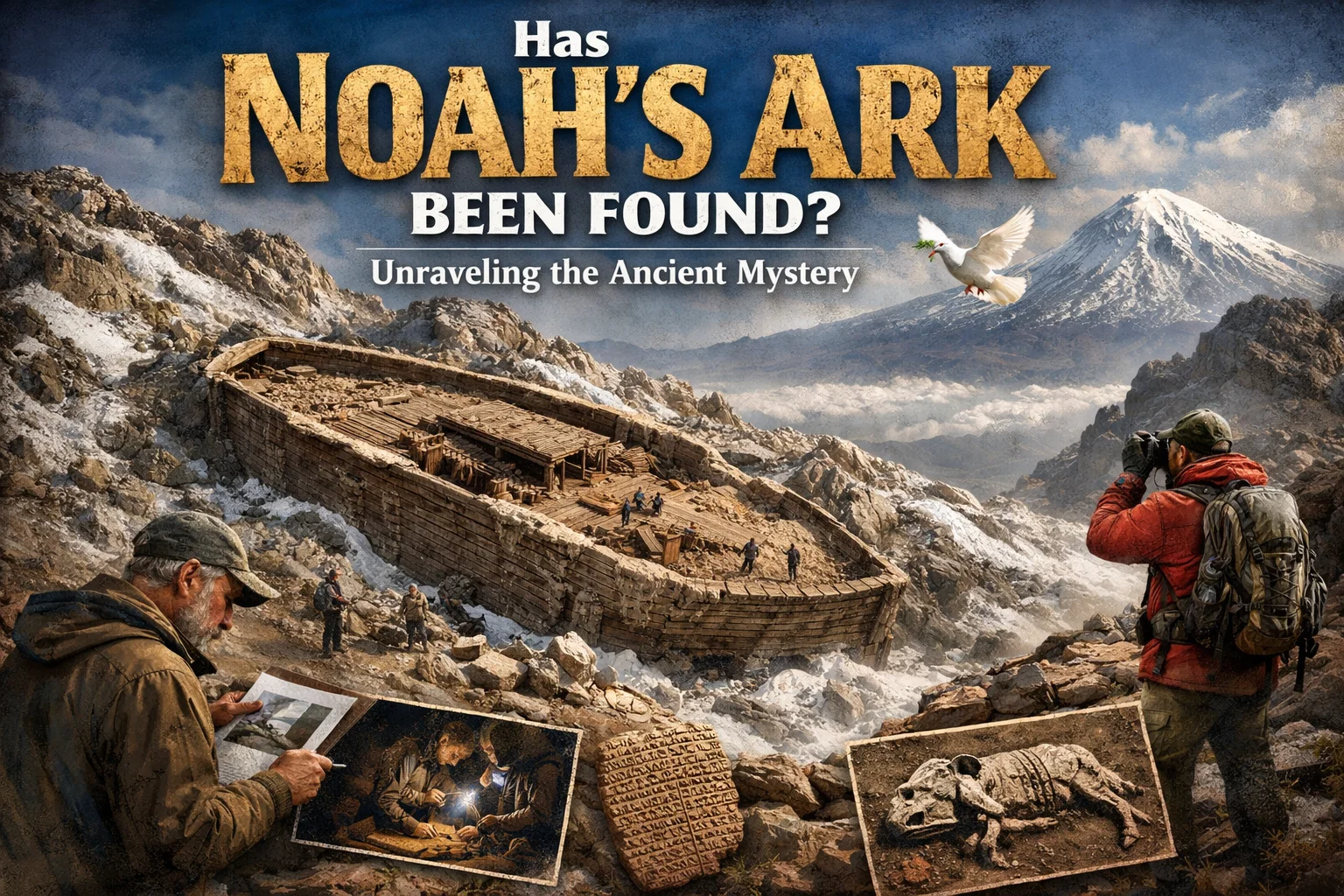
The story of Noah’s Ark is one of those timeless tales that captures the imagination like few others. Rooted in the Bible’s Book of Genesis, it tells of a massive flood sent by God to cleanse the world, with Noah building a gigantic wooden vessel to save his family and pairs of every animal. For centuries, people have wondered if this epic event really happened and, more intriguingly, if the ark itself still exists somewhere out there. Recent claims about Noah’s Ark found in the rugged mountains of eastern Turkey have reignited the debate, blending faith, science, and a dash of adventure. But is there solid proof, or is it just another layer in a long history of tantalizing hints?
As we dive into this topic, it’s worth noting that the search for Noah’s Ark isn’t new—it’s been going on since ancient times. Explorers, scholars, and everyday enthusiasts have scoured remote peaks, analyzed satellite images, and pored over soil samples in hopes of uncovering evidence of Noah’s Ark. The idea that Noah’s Ark found could be hiding in plain sight adds an exciting twist to biblical archaeology. In this article, we’ll explore the claims, the skeptics, and everything in between, keeping things straightforward and engaging. Whether you’re a history buff, a faith seeker, or just curious about ancient mysteries, let’s embark on this journey together.
The Biblical Account of Noah’s Ark: Setting the Stage
The Bible paints a vivid picture of Noah’s Ark as a colossal boat designed to weather the ultimate storm. According to Genesis, God instructed Noah to build the ark from gopher wood, measuring 300 cubits long, 50 cubits wide, and 30 cubits high—roughly translating to about 450 feet in length, 75 feet wide, and 45 feet tall in modern terms. This wasn’t some flimsy raft; it was a three-deck behemoth meant to house animals, food, and Noah’s family for over a year. The floodwaters rose, covering the earth, and when they receded, the ark came to rest on the “mountains of Ararat.” This vague location has fueled endless speculation about where Noah’s Ark found might actually be.
Delving deeper, the story isn’t just about survival—it’s a narrative of renewal and divine promise. After the waters subsided, Noah released a dove that returned with an olive branch, symbolizing hope and new beginnings. Related keywords like “Noah’s Ark dimensions” and “biblical flood story” often pop up in searches because they tie into broader questions about ancient catastrophes. But how does this ancient text hold up against modern discoveries? That’s where things get fascinating, as we’ll see in the claims surrounding potential sites.
The cultural impact of this tale extends far beyond religious texts. It’s inspired art, literature, and even theme parks, reminding us why the quest for evidence of Noah’s Ark remains so compelling. Yet, interpreting the Bible literally versus metaphorically adds layers to the debate. Some see it as historical fact, while others view it as a moral lesson drawn from regional floods in Mesopotamia.
Historical Searches for Noah’s Ark: From Antiquity to Modern Times
Long before satellites and ground-penetrating radar, ancient scholars were already on the hunt for Noah’s Ark. As early as the first century, Jewish historian Flavius Josephus mentioned relics from the ark being shown off in his time. Medieval travelers, including Marco Polo, reported sightings of a wooden structure high in the Armenian mountains, which they believed to be remnants of the vessel. These early accounts, though anecdotal, laid the groundwork for the enduring fascination with Noah’s Ark discovery.
Fast forward to the 19th century, when biblical archaeology exploded in popularity. Expeditions funded by religious groups scoured the region around Mount Ararat, inspired by the Bible’s mention of the “mountains of Ararat.” One notable figure was James Bryce, a British historian who claimed to find a piece of hand-tooled wood at 13,000 feet in 1876. While skeptics dismissed it as debris from a monastery, it sparked a wave of interest. Related terms like “ancient ark relics” highlight how these stories blend history with myth.
In the 20th century, the search intensified with aerial photography during World War II revealing anomalies on Mount Ararat. Russian aviators reportedly spotted a ship-like structure in 1916, but political turmoil in the region halted follow-ups. These historical efforts show a pattern: excitement followed by frustration, as harsh weather and geopolitics often thwarted explorers.
Mount Ararat: The Legendary Resting Place
Mount Ararat, towering at over 16,000 feet in eastern Turkey, has long been the prime suspect for where Noah’s Ark found its final berth. The Bible’s reference to the “mountains of Ararat” points to this volcanic peak, sacred in Armenian lore and visible from miles away. Its snow-capped summit and rugged terrain make it a dramatic backdrop for ark hunters, who brave avalanches and freezing temperatures in pursuit of clues.
Geologically, the mountain is part of a range formed by tectonic shifts, which some argue could have preserved ancient wooden remains under ice. Expeditions in the 1970s and 1980s, led by figures like former astronaut James Irwin, used helicopters and dogsleds to scan the area. They reported dark shapes under the glaciers, fueling speculation about Mount Ararat Noah’s Ark. But concrete evidence? That’s been elusive, with many “discoveries” turning out to be natural rock formations.
Beyond the physical challenges, the site’s location near borders with Armenia and Iran adds layers of complexity. Permits are hard to come by, and local legends of guardians protecting the ark add a mystical element. Despite this, Mount Ararat remains a symbol of hope for those seeking tangible links to biblical history.
The Durupinar Site: A Boat-Shaped Formation in Focus
About 20 miles south of Mount Ararat lies the Durupinar site, a boat-shaped mound that’s become ground zero for recent claims of Noah’s Ark found. Discovered in 1959 by a Turkish army captain via aerial survey, this 515-foot-long formation matches the biblical ark’s dimensions almost perfectly. It’s composed of limonite, a type of iron ore, and sits at around 6,500 feet elevation, making it accessible compared to Ararat’s peaks.
Soil samples from the site have revealed intriguing details, including clay materials, marine substances, and even seafood remnants dating back 3,000 to 5,500 years ago. Proponents argue this aligns with the timeline of the biblical flood, suggesting human activity in an area that should have been underwater. The site’s shape, with rounded ends and a slight bulge in the middle, mimics what an ancient wooden ship might look like after millennia of erosion and mudflows.
Critics, however, point out that the formation is a natural geological feature, formed by landslides and erosion rather than human hands. Despite this, the Durupinar site draws tourists and researchers alike, with its visitor center and plaques explaining the theories. It’s a place where faith and science collide, offering a tangible spot to ponder the possibility of Noah’s Ark discovery.
Ron Wyatt’s Claims: A Controversial Figure in Ark Research
Ron Wyatt, a nurse anesthetist turned amateur archaeologist, burst onto the scene in the 1970s with bold assertions about discovering noah’s ark found. He claimed to have found the ark at the Durupinar site in 1977, complete with petrified wood, metal rivets, and even anchor stones nearby. Wyatt’s stories included radar scans showing internal compartments and lab tests confirming ancient timber, painting a picture of undeniable evidence of Noah’s Ark.
His expeditions were marked by dramatic tales, like surviving earthquakes that allegedly revealed more of the structure. Wyatt also linked the site to biblical figures, suggesting nearby villages were named after Noah’s descendants. While his enthusiasm inspired many, his lack of formal training and unverifiable evidence drew sharp criticism from professionals. Related searches for “Ron Wyatt Noah’s Ark” often lead to debates about pseudoscience versus genuine discovery.
Despite passing away in 1999, Wyatt’s legacy lives on through videos and books. Supporters hail him as a pioneer, while detractors see his work as well-intentioned but flawed. Either way, he popularized the Durupinar site and kept the conversation about Noah’s Ark found alive.
Modern Expeditions and Technology: Scanning for Clues
Today’s ark hunters armed with high-tech tools like ground-penetrating radar (GPR) and electrical resistivity tomography (ERT) are re-examining sites with fresh eyes. In 2019 and 2021, teams from Noah’s Ark Scans conducted detailed surveys at Durupinar, revealing linear subsurface structures and right-angled chambers that suggest artificial design. These findings, including a 13-foot central corridor and layered decks, have sparked renewed excitement about Noah’s Ark found.
Drones and LiDAR mapping have allowed researchers to create 3D models of the formation without disturbing the site. Soil analysis has detected organic materials consistent with decayed wood, and dating places activity around 3,000 BC—close to traditional flood timelines. This blend of technology and archaeology represents a shift from old-school digging to non-invasive exploration.
However, technology isn’t foolproof. False positives from natural rock layers can mimic man-made features, leading to misinterpretations. Still, these methods offer hope for resolving the mystery, turning speculation into data-driven discussions.
Scientific Skepticism: Debunking the Myths
Not everyone is convinced that Noah’s Ark has been found. Geologists argue that the Durupinar formation is a syncline—a natural fold in the earth’s crust shaped by tectonic forces over millions of years. Microscopic studies of supposed “iron brackets” reveal they’re just weathered volcanic minerals, not ancient hardware. This scientific view dismisses claims as pareidolia, where people see patterns like ships in random shapes.
Archaeologists point out the lack of artifacts directly linked to a biblical-era vessel. No inscriptions, tools, or animal remains have surfaced to corroborate the story. The absence of a global flood in geological records further undermines literal interpretations, suggesting the tale might stem from local Mesopotamian floods around 2900 BC.
Despite these rebuttals, skeptics acknowledge the cultural value of the search. It drives interest in history and science, even if the ark itself remains elusive. Balancing doubt with open-mindedness keeps the debate healthy.
Evidence from Soil and Rock Samples
Digging into the dirt at potential ark sites has yielded mixed results. At Durupinar, recent tests show elevated levels of carbon and marine elements, hinting at a submerged past. One study found particles resembling petrified wood, with growth rings suggesting ancient timber. These findings fuel arguments for evidence of Noah’s Ark, especially when dated to the Bronze Age.
Comparisons with nearby sites reveal anomalies: higher concentrations of iron and aluminum than surrounding rocks, possibly from metal fittings. However, experts caution that these could result from natural mineralization. Lab reports vary, with some confirming human intervention and others attributing it to geological processes.
To illustrate, here’s a simple table comparing key sample findings:
| Sample Type | Location | Key Elements Detected | Interpretation |
|---|---|---|---|
| Soil | Durupinar | Clay, marine deposits, carbon | Possible ancient submersion |
| Rock | Mount Ararat | Volcanic minerals, iron | Natural formation |
| Timber-like | Wyatt’s claims | Petrified wood fibers | Debated as artificial or natural |
| Sediment | Black Sea (related floods) | Seafood remnants | Links to regional catastrophes |
This data underscores the ongoing tug-of-war between belief and empirical proof.
Quotes from Experts: Voices in the Debate
As archaeologist Andrew Jones from Noah’s Ark Scans put it, “The dimensions match exactly with the biblical ark, and our scans show internal structures that aren’t random—it’s like peering inside a buried ship.” His words capture the thrill of potential discovery, emphasizing how technology reveals hidden details.
On the flip side, geologist Lorence Collins once stated, “This is a natural rock structure, misidentified due to its boat-like shape. There’s no evidence of wood or construction.” This quote highlights the scientific pushback, reminding us to question extraordinary claims.
Faruk Kaya, a professor involved in Turkish studies, noted, “While ceramic fragments indicate ancient human activity, they don’t prove it’s the ark. More research is needed.” His balanced view bridges faith and fact, encouraging continued exploration.
Cultural Impact: Noah’s Ark in Art and Media
The legend of Noah’s Ark has splashed across canvases, screens, and stages for millennia. From Renaissance paintings depicting the flood’s chaos to modern films like “Evan Almighty,” it symbolizes resilience and divine intervention. This cultural footprint keeps the search for Noah’s Ark found relevant, inspiring documentaries and books that blend history with entertainment.
In literature, authors like Madeleine L’Engle weave ark themes into stories of hope amid disaster. Museums and replicas, such as the full-scale ark in Kentucky, draw millions, turning abstract tales into immersive experiences. Related keywords like “Noah’s Ark in pop culture” reveal its enduring appeal.
Beyond entertainment, the story influences environmental discussions, paralleling modern concerns about climate change and floods. It’s a reminder that ancient narratives still resonate today.
Comparative Myths: Flood Stories Around the World
noah’s ark found tale isn’t unique—similar flood myths appear in cultures worldwide, from the Mesopotamian Epic of Gilgamesh to Hindu legends of Manu. In Gilgamesh, Utnapishtim builds a boat to survive a deluge sent by gods, echoing biblical details like releasing birds to test the waters. These parallels suggest a shared memory of real events, perhaps massive regional floods.
Native American tribes tell of canoes saving ancestors from rising seas, while Greek myths feature Deucalion’s ark-like chest. Exploring these “global flood legends” enriches our understanding of Noah’s Ark discovery, hinting at common human experiences.
Scholars debate if these stories stem from a single source or independent catastrophes. Either way, they add depth to the biblical narrative, showing it’s part of a broader tapestry.
The Role of Faith in the Search
For many, the quest for Noah’s Ark found is as much about spiritual affirmation as physical proof. Believers see potential discoveries as validations of scripture, strengthening their faith in divine history. Churches and organizations fund expeditions, viewing them as missions to uncover God’s handiwork.
Yet, faith doesn’t require artifacts. As one theologian quipped, “The ark’s true legacy is in the heart, not the hills.” This perspective allows room for mystery, where absence of evidence isn’t evidence of absence.
Interfaith dialogues also emerge, with Muslims referencing the Quran’s similar story, fostering unity amid differences.
Challenges of Exploration: Weather, Politics, and Terrain
Hunting for the ark isn’t a walk in the park—literally. Mount Ararat’s blizzards and crevasses pose deadly risks, with past expeditions facing frostbite and rockslides. Political tensions in the region, including border disputes, require navigating bureaucracy for access.
Modern tools help, but nothing beats boots on the ground. Logistical hurdles like transporting equipment to remote areas add to the adventure—and the frustration.
Despite obstacles, perseverance pays off, with each trip yielding new insights, even if not the ark itself.
Future Prospects: What Lies Ahead in Ark Research
Looking forward, advancements in AI and satellite imaging could revolutionize the search for Noah’s Ark found. Teams plan more GPR surveys and core drilling at Durupinar, aiming for definitive proof. International collaborations might ease access to restricted zones.
Crowdfunding and virtual reality could democratize exploration, letting anyone “join” expeditions from home. As technology evolves, so does hope for closure.
But will we ever find it? The jury’s out, but the journey continues to captivate.
Conclusion
After sifting through centuries of searches, modern scans, and scientific scrutiny, the question of whether noah’s ark found remains open. Claims from sites like Durupinar offer tantalizing hints—matching dimensions, ancient materials, and subsurface structures—that align with biblical descriptions. Yet, geological explanations and lack of irrefutable artifacts keep skepticism alive. The story endures because it touches on profound themes: survival, faith, and humanity’s place in the cosmos.
Ultimately, the true value might not be in finding wooden planks but in the inspiration it provides. Whether Noah’s Ark discovery proves real or symbolic, it reminds us of our shared quest for meaning. As explorations continue, one thing’s certain: the mystery of Noah’s Ark will keep drawing us in, blending ancient wonder with modern curiosity.
FAQ
Is There Solid Evidence That Noah’s Ark Has Been Found?
No definitive proof exists that Noah’s Ark has been found, but sites like Durupinar show promising features. Soil tests reveal ancient human activity and materials dating to flood-era timelines, yet geologists argue it’s natural. Ongoing research with radar and dating methods keeps the possibility alive, though many view it as interpretive.
The debate hinges on balancing biblical accounts with science. While some see the boat-shaped formation as evidence of Noah’s Ark, others point to erosion patterns. Future digs might clarify, but for now, it’s a mix of faith and facts.
Where Is the Most Likely Location for Noah’s Ark?
Mount Ararat and the nearby Durupinar site in eastern Turkey top the list for where Noah’s Ark might be found. The Bible mentions the “mountains of Ararat,” making this region a focal point. Expeditions have focused here due to its elevation and geological anomalies.
Alternative theories suggest other peaks, like Mount Judi, based on Quranic references. Accessibility and tech scans favor Durupinar, with its shape matching scriptural specs.
Who Was Ron Wyatt and What Did He Claim About Noah’s Ark?
Ron Wyatt was an amateur archaeologist who claimed to discover Noah’s Ark at Durupinar in the 1970s. He reported finding petrified wood, rivets, and anchor stones, using radar to map internal structures.
His work inspired many but faced criticism for lacking peer review. Wyatt’s legacy includes popularizing the site, though professionals question his methods.
How Do Flood Myths from Other Cultures Relate to Noah’s Ark?
Many cultures have flood stories similar to Noah’s, like the Epic of Gilgamesh, suggesting shared origins. These tales often feature a hero building a boat to save life from divine wrath.
Such parallels bolster arguments for a historical basis, possibly from Mesopotamian floods. They enrich the Noah’s Ark narrative without proving its specifics.
Could Modern Technology Finally Prove Noah’s Ark Exists?
Advances like GPR and drones offer hope for confirming if Noah’s Ark has been found. Recent scans show chamber-like features, but interpretations vary.
While tech enhances detail, conclusive proof needs artifacts. Continued innovation might tip the scales, but nature’s mimicry poses challenges.
What Would Finding Noah’s Ark Mean for Science and Faith?
Discovering Noah’s Ark found could bridge science and religion, validating biblical history. It might spark new archaeological insights into ancient shipbuilding.
