


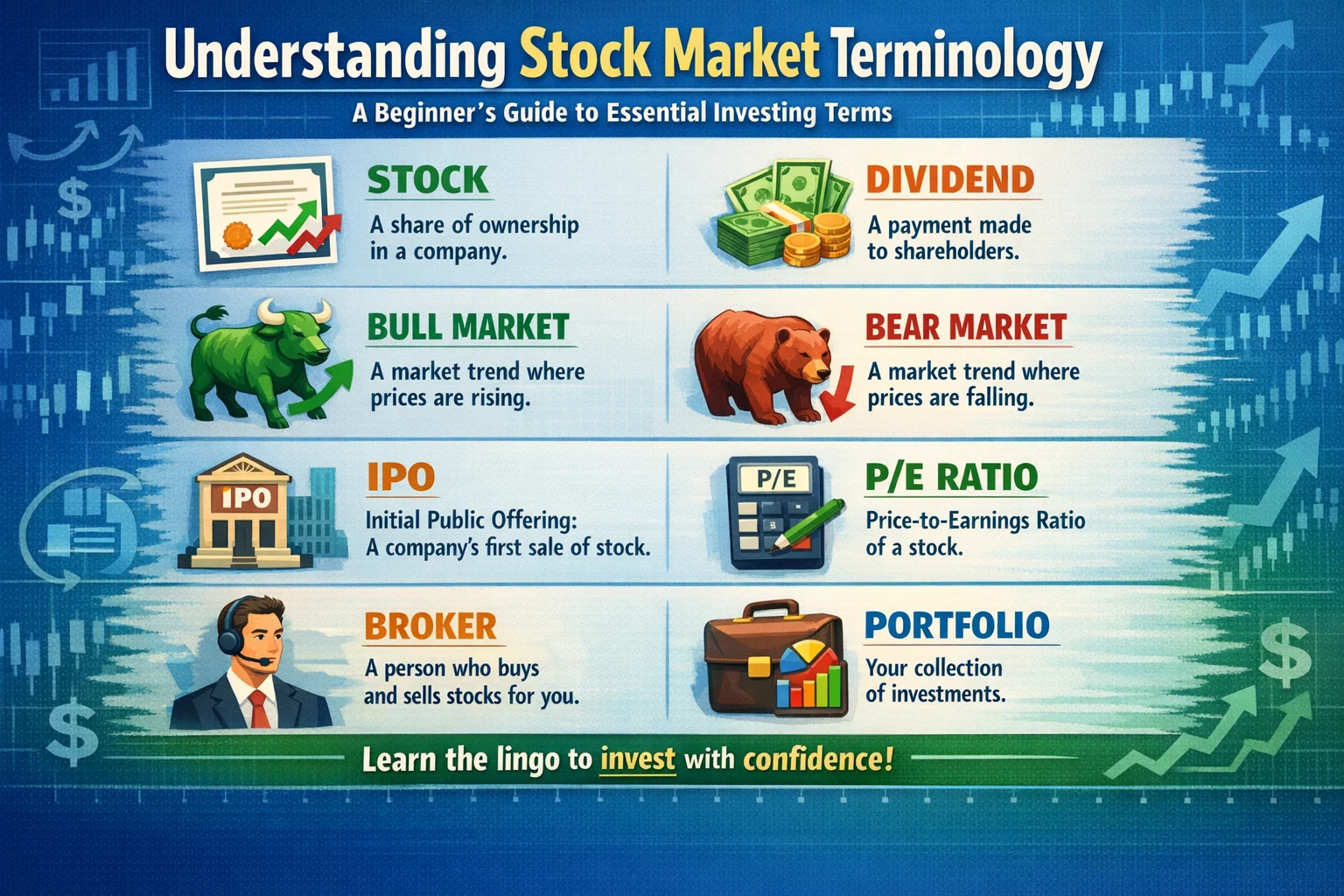
Diving into the world of investing can feel like learning a new language at first. All those buzzwords flying around on financial news or in conversations with friends who seem to know it all—it’s totally normal to feel a bit overwhelmed. But here’s the good news: grasping basic stock market terminology doesn’t have to be complicated. In fact, once you get the hang of the key concepts, you’ll start seeing the stock market not as some mysterious beast, but as a tool you can use to grow your money over time.
Think of stock market terminology as the foundation of smart investing. It helps you make sense of headlines, understand what analysts are saying, and make decisions that align with your goals. Whether you’re eyeing your first share purchase or just curious about how it all works, knowing these terms empowers you. It’s like having a map in unfamiliar territory—it guides you, reduces risks, and makes the journey way more enjoyable. In this guide, we’ll break down the essentials in a straightforward way, so you can navigate the markets with more confidence.
Basics of Stocks and Shares
At the heart of stock market terminology are stocks themselves. A stock, also called a share or equity, represents a tiny piece of ownership in a company. When you buy a stock, you’re essentially becoming a part-owner of that business. Companies issue stocks to raise money for growth, and in return, investors like you get the potential for profits through price appreciation or dividends.
There are two main types: common stocks, which give you voting rights and possible dividends, and preferred stocks, which usually prioritize dividend payments but often without voting power. Common stocks are what most beginners start with because they offer more upside potential if the company does well. Understanding this distinction in stock market terminology is key because it affects how you might earn returns—either from the stock price going up (capital gains) or from regular payouts.
Free Stock Certificate Templates to Edit
Another foundational term is market capitalization, or market cap. This is simply the total value of a company’s outstanding shares—calculated by multiplying the current stock price by the number of shares available. It categorizes companies into large-cap (big, stable giants), mid-cap (growing firms), and small-cap (smaller, often riskier but with higher growth potential). Market cap helps you gauge a company’s size and risk level within stock market terminology.
To illustrate, here’s a simple table of market cap categories:
| Category | Market Cap Range (Approximate) | Characteristics | Examples |
|---|---|---|---|
| Large-Cap | Over $10 billion | Stable, established companies | Apple, Microsoft |
| Mid-Cap | $2 billion to $10 billion | Growth potential, moderate risk | Smaller tech or retail firms |
| Small-Cap | Under $2 billion | High growth, higher volatility | Emerging startups |
This breakdown shows why diversifying across categories is smart—it’s all part of building a balanced approach using core stock market terminology.
Bull and Bear Markets Explained
One of the most iconic parts of stock market terminology is the bull and bear distinction. A bull market happens when prices are rising or expected to rise, often driven by economic growth, low unemployment, or investor optimism. It’s named after how bulls charge with their horns upward—symbolizing upward momentum. In these periods, confidence is high, and buying tends to dominate.
On the flip side, a bear market is when prices fall 20% or more from recent highs, usually amid economic slowdowns, high inflation, or uncertainty. Bears hibernate or swipe downward, mirroring the declining trend. Bear markets can be tough emotionally, but they’re normal cycles—historically, bull markets last longer and deliver stronger gains.
Warren Buffett once said, “Be fearful when others are greedy, and greedy when others are fearful.” This quote perfectly captures the mindset shift needed during bull and bear phases in stock market terminology. Many experts advise staying invested through both, as timing the market perfectly is nearly impossible.
These cycles highlight volatility, another key term meaning how much prices fluctuate. High volatility means big swings, which can create opportunities but also risks. Understanding bull and bear dynamics helps you avoid panic selling in down times or overbuying in euphoric ups.
Dividends and Yield: Passive Income from Stocks
Dividends are a favorite in stock market terminology for income-focused investors. They’re portions of a company’s profits paid out to shareholders, usually quarterly. Not all companies pay dividends—growth-oriented ones like tech startups often reinvest everything—but mature firms in utilities or consumer goods frequently do.
Dividend yield is the annual dividend payment divided by the stock price, expressed as a percentage. A higher yield can signal good income potential, but it’s wise to check if it’s sustainable. For example, a $50 stock paying $2 yearly in dividends has a 4% yield.
Here’s a quick comparison table of dividend types:
| Type | Description | Pros | Cons |
|---|---|---|---|
| Cash Dividends | Direct payments to shareholders | Reliable income | Taxed as ordinary income |
| Stock Dividends | Additional shares instead of cash | Compounds ownership | Dilutes share value slightly |
| Special Dividends | One-time large payouts | Big windfall | Not recurring |
Companies with consistent dividend growth are called dividend aristocrats, often prized for reliability. As Peter Lynch noted, “Dividends are the unsung heroes of investing.” They provide income even in flat markets, making them a cornerstone of long-term strategies in stock market terminology.
Portfolio Diversification and Asset Allocation
Don’t put all your eggs in one basket—this old saying is gold in stock market terminology, especially for diversification. It means spreading investments across different assets, sectors, or regions to reduce risk. If one stock tanks, others might hold steady or rise, balancing things out.
Asset allocation is deciding how much of your portfolio goes to stocks, bonds, cash, or alternatives like real estate. A common rule: subtract your age from 100 for your stock percentage (e.g., 30-year-old might aim for 70% stocks). This evolves with your risk tolerance and goals.
Asset Allocation, Investment Diversification And Put All Eggs In …
Diversification ties into risk management. High-risk assets like small-cap stocks offer big rewards but volatility; bonds provide stability. ETFs and mutual funds make diversification easy for beginners by bundling many assets.
Ray Dalio famously said, “The biggest mistake investors make is to believe that what happened in the recent past will continue.” Diversifying helps weather changes, turning stock market terminology into practical protection.
Trading Basics: Orders, Bid/Ask, and Volume
When buying or selling, stock market terminology includes order types. A market order executes immediately at the current price—fast but no price guarantee. Limit orders set a specific price, only filling if matched—great for control.
Bid is the highest price buyers offer; ask is the lowest sellers accept. The bid-ask spread is the difference, narrower for liquid stocks. Volume is shares traded daily—high volume means strong interest and easier trading.
Trading Floor: Definition, Overview, Applications
Trading floors, once bustling hubs, are now mostly electronic, but the excitement remains. Understanding these basics prevents costly mistakes, like paying more than needed due to wide spreads.
Valuation Metrics: P/E Ratio, EPS, and More
Valuation is crucial in stock market terminology. Earnings per share (EPS) is profit divided by outstanding shares—a higher EPS signals profitability. Price-to-earnings (P/E) ratio is stock price over EPS; low P/E might mean undervalued, high could indicate growth expectations.
Other metrics: Price-to-book (P/B) compares price to net assets; return on equity (ROE) shows profit efficiency.
Benjamin Graham advised, “In the short run, the market is a voting machine but in the long run, it’s a weighing machine.” These metrics help weigh true value beyond hype.
Indexes, ETFs, and Mutual Funds
Indexes like the S&P 500 or Dow Jones track market performance—benchmarks for comparison. ETFs are baskets traded like stocks, offering instant diversification. Mutual funds pool money for professional management, often with higher fees.
These tools democratize investing, letting beginners access broad markets without picking individual stocks.
Risk, Volatility, and Long vs. Short Positions
Risk is potential loss; volatility measures price swings. Long positions bet on rises; short selling borrows to sell high, buy low later—risky but used in bears.
As Jesse Livermore said, “The speculator’s chief enemies are always boring from within—ignorance, greed, fear, and hope.”
Advanced Concepts: Margin, Options, and IPOs
Margin trading borrows money for bigger bets—amplifies gains/losses. Options give rights to buy/sell at set prices. IPOs are companies going public.
These add complexity, so master basics first.
Conclusion
Wrapping up our deep dive into stock market terminology, remember that knowledge is your best asset. From stocks and dividends to diversification and valuation, these terms aren’t just jargon—they’re tools for building wealth patiently. Markets fluctuate, but informed investors who stay disciplined often come out ahead. Start small, keep learning, and enjoy the process. You’ve got this.
FAQ
What is the most important stock market terminology for beginners?
Stock market terminology basics like stocks, dividends, bull/bear markets, and diversification are essential. They form the foundation for understanding how investing works without getting overwhelmed.
How does a bull market differ from a bear market in stock market terminology?
In stock market terminology, a bull market features rising prices and optimism, while a bear market involves falling prices (typically 20%+ drop) and pessimism. Both are normal cycles.
Why is dividend yield key in stock market terminology?
Dividend yield, part of core stock market terminology, shows income from dividends relative to price. It’s great for evaluating income stocks sustainably.
What role does diversification play in stock market terminology?
Diversification in stock market terminology means spreading investments to cut risk. It’s like not putting all eggs in one basket—crucial for long-term stability.
How do P/E ratios fit into stock market terminology?
P/E ratio is vital stock market terminology for valuation—price divided by earnings. Low might signal value; high could mean growth or overvaluation.
Can understanding stock market terminology help avoid common mistakes?
Absolutely—knowing stock market terminology like volatility, margin, and orders helps spot risks, avoid emotional decisions, and invest smarter.
